Luang Prabang & Laos with LT Travel

On the agenda this day

Thursday 29 August 2019

OCTOBER – SEPTEMBER 27–30

1 / 4

Exhibition at TAEC - Traditional Music

  • From 27 October 2018 at 09:00 to 30 September 2020 at 18:00

TAEC’s newest special exhibition, “Voices of the Wind: Traditional Instruments in Laos” is now on display after more than two years of extensive research and documentation in remote regions of northern Laos led by Belgian ethnomusicologist and curator, Dr. Marie-Pierre Lissoir, and the TAEC research team.

A highly interactive and intimate exhibit, display spaces communicate three important contexts of instrumental practices: ritual, instrument-making, and courting. Through village scene re-creation, audio stations, and interactive video and photograph kiosks, visitors will enter a world rarely seen by the general public.

In Laos, music and musical instruments are a part of everyday life. For entertainment, courtship, or rituals, to banish loneliness, teach children, or communicate with the spirits, musical practices touch every member of a community during every part of the year. There is now a struggle and urgency to document these instruments from construction to playing as modernity takes over and replaces intimate settings and songs with amplifiers, microphones, and pre-recorded music. Music is the voice of a community, the voice of a country. A voice that is constantly evolving, like every human activity.

This exhibit also coincides with the recent UNESCO inscription of the music of the mouth organ or “khaen” on the Representative List of the Intangible Cultural Heritage of Humanity. This is the very first inscription for the country on the ICH list and a positive step forward for safeguarding the transmission of knowledge, skills, and meaning of this emblematic instrument for future generations.

TAEC would like to acknowledge the U.S. Ambassadors Fund for Cultural Preservation for making this critical research possible, and William Klausner for supporting the creation of the exhibition.

“Voices of the Wind: Traditional Instruments in Laos” will be on display until the Fall 2020.

From the Curator: “Music can be explored in so many ways. There is the role of music in traditional ceremonies and celebrations, but also the crafting of instruments, playing techniques, and the decline of apprenticeship. Laos is particularly fascinating because many instruments are used to communicate, whether to pass a message through the mountains with the powerful sound of a leaf, or to express ones love with the discreet sound of the jaw harp. Speaking about music is speaking about life in Laos, its changes and challenges.”– Dr. Marie-Pierre Lissoir

Hmong instrument maker and musician: “There are so many people making qeej, but if I am the one who is able to help document the process of making it from the beginning to the end, then I hope my knowledge is able to inspire people not to let go of their culture and traditions, not to let go of your ancestors and family spirits. I want to leave this message behind for the future generation.”– Mr. Neng Chue Vang

TAEC’s objectives of this exhibition:

  • Demonstrate the diversity and similarities in musical practices among minority groups in Laos.
  • Expose unexpected sounds and instruments to visitors in an innovative experiential space. The scenography of the exhibit and its use of different mediums will allow a deeper understanding of music and its techniques.
  • Stimulate local and foreign visitor interest in Laos’ musical traditions and its importance to society through special events and outreach at the Centre.
  • Highlight, document and safeguard endangered practices and instruments. 


Discover the people of Laos at the Traditional Arts & Ethnology Centre. TAEC is the only museum and learning centre in Laos dedicated to cultural diversity. The Centre is engaged in a broad range of museum and community engagement activities, reflecting its commitment to supporting living ethnic minority communities to preserve and promote their cultural heritage while looking towards the future.

Located in Ban Khamyong, Luang Prabang, Lao PDR, the museum and shop is open 9am until 6pm, closed Mondays. Admission is 25,000 Lao kip for adults, free for children under 12 and Lao citizens. The TAEC Boutique on the main road in Ban Vat Sene sells fair trade crafts made by ethnic groups. It is open from 9am – 9pm every day.

Contact:
Kristy Best, Director Sales & Marketing
kristy taeclaos.org
www.taeclaos.org
Mobile +856 20 5544 7895

See the event page

Back to the programme

AUGUST 29

2 / 4

New Moon day

  • Thursday 29 August 2019

Van Sin 1 Kham

The day of the new moon is called "Van Sin Ngiae 1 kham". It’s a holiday, especially for all manual workers and those whose job can disturb by noise. These days we will avoid visiting villages working in handicraft, if we want to observe or participate in their activities.

On that day, more locals will join the Morning Alms.

Before participating, we recommend to read the Rules to respect for this unique cultural/religious tradition.

Notice that Buddhist holidays often coincide with Buddhist festivals and animist festivals.

See the event page

Back to the programme

AUGUST 29

3 / 4

Ho Khao Padabdine day

  • Thursday 29 August 2019

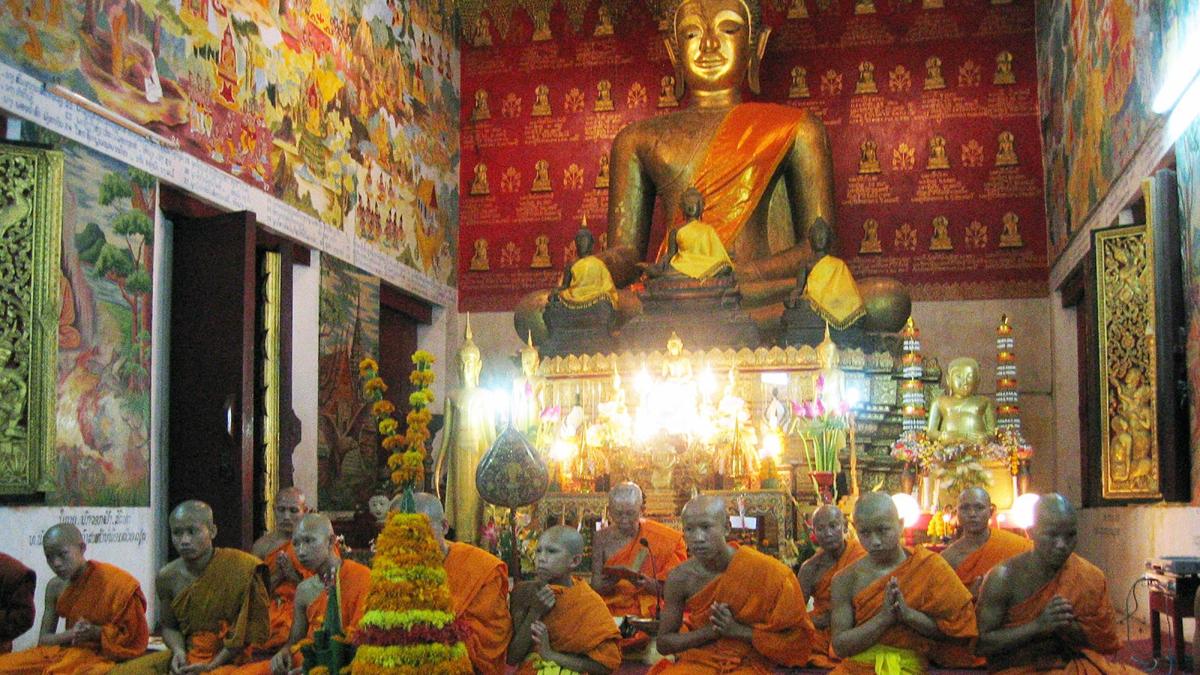
The 14th day of the waning moon of the ninth month of Buddhist calendar, all Laotians annually celebrate the feast of Ho Khao Padabdine, the "Day of the Dead". That day, the Buddhist make a donation to the death, in the form of food delivered to them symbolically through the monks ...

Ho Khao Padapdine means’’ to packets of rice and place them on the floor’’.

According to the precepts of Buddha, the Buddhist Lent is the good time to refrain from bad deeds. Buddhist should apply the Dharma: the respect of the five commandments of the Buddha, meditation and alms. It is also time to complete the agricultural work, as transplanting of paddy.

To celebrate the Boun Khao Padabdine Ho, the Buddhist are preparing offerings composed of Tomh Khao, Khao Nom Neb (cakes made with rice), fruits and other kind of foods that will be offered to monks . These religious activities are intended to honor the dead and the spirits.

The eve of the festival, families put their donations in a plastic container or trays. Part of the food offerings for the ancestors are placed in containers made of paper or banana leaves.

So in this moonless night, deep in the dark (between three and four in the morning), faithful deposit salty food, fruit and cakes, betel quids and cigarettes at the foot of stupas containing the ashes of the dead, or under the trees... During the night time, the dead are allowed to come collect these donations.

The feast day, at dawn, the sound of drums from pagodas diffuses through the streets of towns and villages. It announces the gathering of the faithful for the ceremony of offerings to the pagoda in their neighborhood. The villagers bringing gifts. At the entrance, you can see some devotees make offerings to victims of violent death and the dead who have no family to come to honor them ... All who died a violent death can not be met in the temple, and in this case, their parents and relatives must honor them by hanging offerings on poles or on the closing of the pagoda ...

The Buddhist belief on reincarnation, but all do not suffer the same fate. If the deceased had a good behavior throughout his life, he will attain Nirvana; if he has committed many sins, he is condemned to stay in hell where he will be reincarnated in the body of a animal to atone for his sins.

The dead who go to hell will suffer many sufferings and be deprived of food and clothing.

After death, Nirvana and Hell are places where the faithful are called to be reborn. Lao Buddhists also believe that the dead can come back from hell, and that fifteen days per year. Thus, the 14th day of the waning moon of the ninth month on the 15th day of the waxing moon of the 10th calendar month Lao (this year from 20 August to 4 September), Chia Nhomphibane, the king of hell, tortured authorizes to return to the human world to receive the offerings of their offspring during the Christmas Ho Ho Khao and Khao Salak Padabdine.

If the dead returning to earth don’t find any offering, they cry and throw curses on people who didn’t give respect and attention.

From an article of KPL, Lao News Agency, translated by Google

See the event page

Back to the programme

AUGUST 29

4 / 4

1st boat racing

  • Thursday 29 August 2019
  • Luang Prabang

Mid-Lent begins the canoe races, which will take place over 1.5 lunar cycles (approximately 6 weeks) before the finals, which will be held at the end of Buddhist Lent.

In mid-term of the Buddhist Lent, at the time of the new moon, the biggest boat race takes place in the Nam Khan River, in the center of the town of Luang Prabang. It is a very popular event and many people from the countryside and all over the country take this opportunity to come in to town.

The day before, a large street market will be held from 6 am to 12 am, located on the site of the old stadium, providing products from Thailand for a period of one week.

These holidays, with that of Pimay and the end of Lent Buddhist, are the busiest of the year.

See the event page

Back to the programme

All upcoming events

A question, a trip in mind?

Contact

Get in touch

Your message

Find us

Ban Aphai
Luang Prabang - 06000 Laos